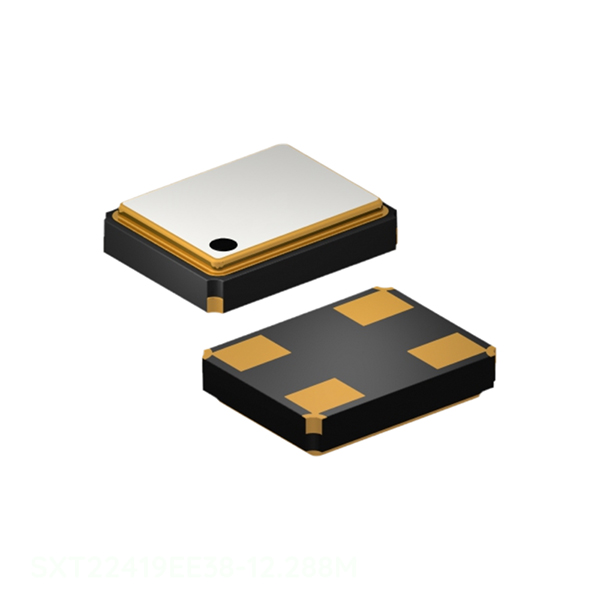
It is packaged internally with quartz crystal resonators, oscillation driver ICs, voltage regulators, and feedback circuits, providing extremely low jitter and high stability clock references for high-speed electronic systems. The mainstream output levels include LVDS, LVPECL, HCSL, etc.
Features:
1. Super anti-interference ability
Common mode suppression: External electromagnetic interference (EMI) will couple to both the CLK+and CLK - lines simultaneously, and the system receiver can completely cancel out common mode noise by comparing the difference between the two.
Low radiation: The direction of differential signal current is opposite, and the electromagnetic fields generated cancel each other out, resulting in much less external radiation interference than single ended signals.
2. Extremely low phase noise and jitter
The phase jitter of high-end differential crystal oscillators can be as low as femtosecond (fs) level (such as 44fs @ 156.25MHz), far superior to the picosecond (ps) level of ordinary CMOS crystal oscillators, and is a necessary guarantee for high-speed serial data (SerDes).
3. High speed signal integrity is good
The output edge is steep (with extremely short rise/fall time), and the signal symmetry is high, suitable for * * 100MHz~625MHz+* * ultra-high frequency scenarios.
Strong driving capability, supporting long-distance and high-speed PCB routing, with minimal signal attenuation.
4. Electrical Characteristics
Packaging: The mainstream is SMD (7050, 5032, 3225, 2520) with 6 pins.
Voltage: Commonly used 3.3V, some 2.5V low-power models.
Temperature range: industrial grade (-40 ℃~+85 ℃), wide temperature range (-40 ℃~+105 ℃).
Output level:
LVDS: Low power consumption, universal (Ethernet, video interface).
HCSL: Low jitter, designed specifically for PCIe Gen4/5.
LVPECL: High speed, low noise, suitable for optical communication and high-frequency ASIC.
Applications:
1. Communication and Data Center
5G/6G base station, optical module (100G/400G/800G/1.6T), switch/router.
Provide 156.25MHz and 312.5MHz clocks for SerDes and Ethernet MAC.
2. High Performance Computing (HPC)
Server, AI acceleration card FPGA/ASIC。
PCIe Gen4/5, DDR5/6 high-speed bus reference clock (usually 100MHz HCSL).
3. High end Industry and Medical
High speed ADC/DAC, precision measuring instruments, medical imaging equipment.
Require an automated control system with extremely low jitter and high synchronization accuracy.
4. Automotive Electronics
Meet the requirements of wide temperature, anti vibration, and high reliability for automotive grade (AEC-Q100).