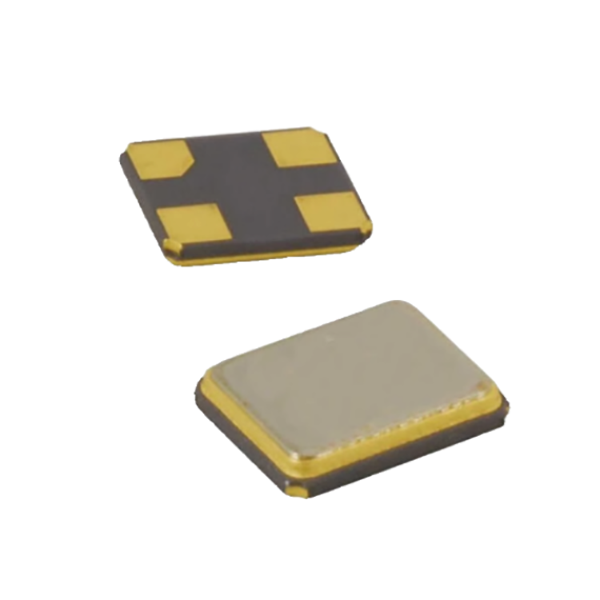
It uses semiconductor microfabrication technology to etch tiny MEMS resonant structures on quartz chips, combined with CMOS oscillation circuits, to output precise and stable clock signals, which is a high-performance upgrade solution for traditional quartz crystal oscillators.
Features:
1. Ultra high stability and accuracy
Inheriting the low phase noise and high frequency stability characteristics of quartz crystals.
Built in temperature compensation, the frequency error in the full temperature range (-40 ℃~+85 ℃/+125 ℃) can be as low as ± 10-30ppm.
2. Miniaturization and Thinning
Adopting standard SMD packaging (such as 2520, 3225, 5032), the size is much smaller than traditional quartz crystal oscillators, suitable for high-density PCBs and portable devices.
3. Strong reliability and resistance to environmental interference
Seismic/impact resistance: Silicon based MEMS structures have high strength and vibration resistance, which is 10-25 times that of traditional quartz crystal oscillators.
Wide temperature operation: Supports extreme temperature environments ranging from -40 ℃ to+125 ℃.
Long lifespan: The mean time between failures (MTBF) far exceeds that of traditional crystal oscillators.
4. High flexibility and programmability
Supports broadband output (commonly 1MHz~200MHz), and a single device can cover multiple frequency points.
Supports multiple voltages (1.8V, 2.5V, 3.3V) and multiple output formats (CMOS, LVDS, LVPECL).
5. low power consumption
Low working current, suitable for battery powered IoT, wearable and other low-power devices.
Applications:
1. Consumer electronics: smartphones, tablets, smartwatches, TWS earphones.
2. Communication equipment: 5G base station, router, switch, optical module (requiring low jitter clock).
3. Automotive electronics: ADAS (Advanced Driver Assistance Systems), in car navigation, autonomous driving sensors.
4. Industrial control: PLC, industrial automation, measuring instruments, IoT gateway.