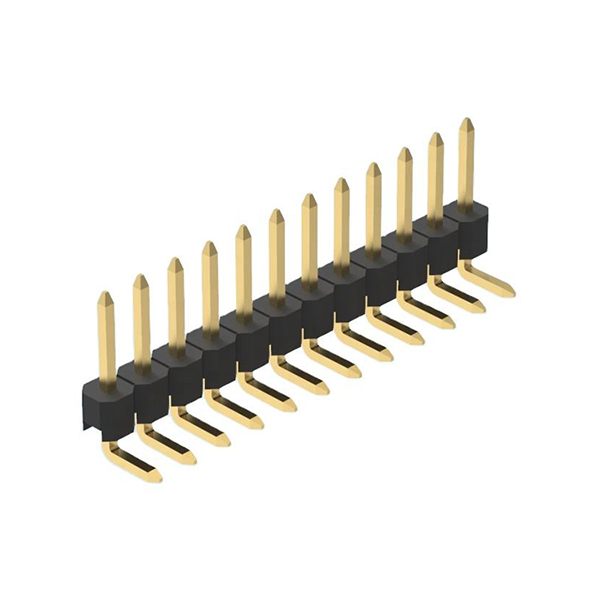
Features:
1. Standardization and strong compatibility
The mainstream spacing (such as 2.54mm) is an international standard, which can perfectly match with universal accessories such as DuPont wire, IDC wire, and busbar, and has strong universality.
2. Low cost and simple structure
Mature design and manufacturing processes make it one of the most cost-effective connector types, suitable for large-scale production.
3. Excellent electrical performance
The pins are mostly made of brass/phosphor bronze material, with gold/tin plating on the surface, high conductivity, low contact resistance, oxidation and corrosion resistance, ensuring signal stability.
4. Flexible and versatile, with wide adaptability
The specifications (spacing, number of rows, needle length, installation method) are extremely rich, which can meet the design needs of different scenarios such as ultra-thin, high-density, and high current.
5. Reliable connection and easy maintenance
The plug-in structure facilitates the testing, maintenance, and upgrading of modules; Closely coordinated, with certain anti vibration and anti loosening capabilities.
Applications:
1. Consumer electronics: internal module connections such as computer motherboards, graphics cards, hard drives, routers, set-top boxes, etc.
2. Embedded development: I/O port expansion and module docking for Arduino, Raspberry Pi, STM32 and other development boards.
3. Industrial control: Signal and power connections for PLCs, frequency converters, sensors, and industrial control motherboards.
4. Instrumentation: Internal PCB connections for measuring equipment, medical devices, oscilloscopes, etc.
5. Automotive electronics: internal circuit connections for in car navigation, audio, and control systems.
6. DIY and Maker: Electronic Manufacturing, Circuit Experimentation, Robotics, Smart Home Projects.