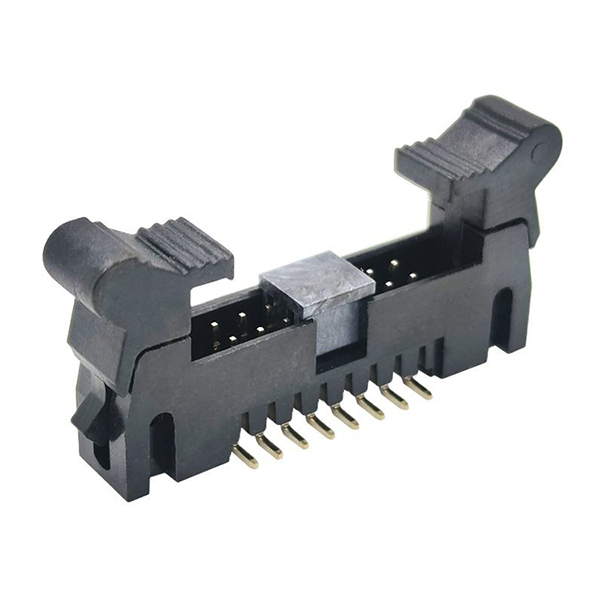
Ejector header connector is a wire to board/board to board connector with double-sided buckles, named after the plastic buckles on both sides used for locking that resemble cow horns. It is mainly used in conjunction with IDC cables to achieve signal and weak current connections between PCB boards or between boards and cables, and is a commonly used component for internal connections in electronic devices.
Features:
1. Self locking and anti detachment: The "cow horn" buckles on both sides automatically lock after insertion, resist pulling and vibration, and have a stable connection, effectively preventing the equipment from loosening in a vibrating environment.
2. Easy to plug and unplug: No tools required, press the buckle to unlock, support quick connection and disconnection, facilitate device debugging, maintenance, and module replacement.
3. Electrical performance
Material: The terminals are mostly made of phosphor bronze/brass, with gold or tin plating on the surface to ensure excellent conductivity, oxidation resistance, and corrosion resistance.
Insulation: The shell is commonly made of high temperature resistant and flame-retardant (UL94 V-0) engineering plastics such as PBT and LCP, which have good insulation properties.
4. Mechanical lifespan: Strong durability, with a standard insertion and extraction lifespan typically ≥ 500 times.
5. Diverse specifications: There are various packaging options including * * straight pin, bent pin, SMT * *, etc., which are suitable for different PCB installation needs.
Applications:
1. Industrial control: Signal connections between modules within PLCs, industrial computers, and frequency converters.
2. Communication equipment: connection between switches, router motherboards, interface cards, and power boards.
3. Embedded/Development Board: GPIO extensions and module connections for Arduino, Raspberry Pi, and FPGA development boards.
4. Testing equipment: testing fixtures, aging racks, used for quickly switching the tested circuit board.
5. Automotive Electronics: Connection of modules such as car audio, dashboard, BMS (Battery Management System), etc.
6. Consumer electronics: interconnection of boards within televisions, printers, and servers.