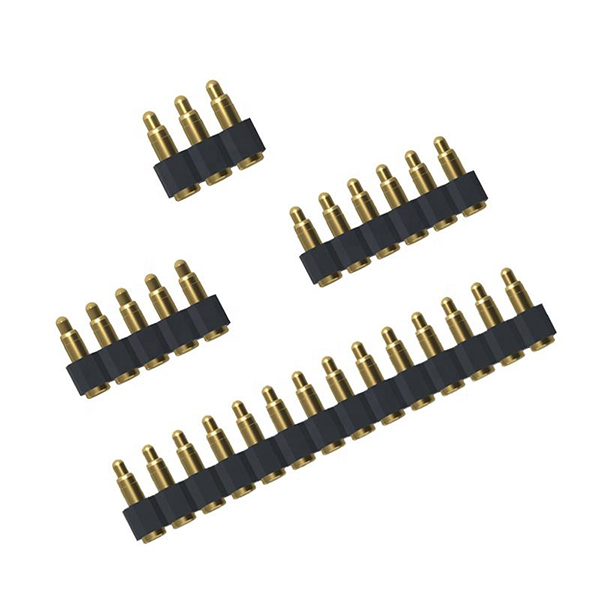
Pogo pin connector is a spring type probe connector composed of three precision components: needle shaft, spring, and needle tube, which are riveted together. The stable electrical connection with the docking component is achieved through the elastic pressure provided by the internal spring, with the core function of current transmission and signal connection.
Features:
1. High reliability: The elastic contact structure can automatically compensate for tolerances and maintain stable conductivity in dynamic environments such as vibration and impact.
2. Ultra long lifespan: High quality products typically have a plug and unplug lifespan of over 10000 times, while customized products can have a lifespan of 50000 to 100000 times.
3. Excellent electrical performance
Low impedance: The surface is generally gold-plated, and the normal contact resistance can be stable ≤ 30m Ω.
High current: Conventional models support 0.5-3A, while high current models can carry 5A-60A.
High frequency signal: with small impedance fluctuations, it can adapt to 30GHz high-frequency scenarios.
4. Miniature high-density: capable of achieving a very small diameter of 0.4mm and a micro spacing of 0.2mm, supporting high-density array layout with multiple pins.
5. Strong environmental adaptability: The gold-plated coating has excellent anti-corrosion and anti-oxidation capabilities.
Applications:
1. Consumer electronics
Smart wearables: Magnetic charging contacts for smartwatches and TWS earphones.
Mobile phone/tablet: internal module connections, antenna contacts, testing points.
Laptop computer: signal connection for keyboard and touchpad.
2. Automotive Electronics
Car display screen HUD、 Connect the signals and power supply of devices such as cameras and radars.
Seat heating/ventilation, modular control unit interface.
3. Medical equipment
Battery and signal connections for handheld detectors and portable medical devices.
High precision sensor interface ensures stable transmission of weak signals.
4. Sensor connections for industrial robots and drones.
Low voltage signal connections for car audio, navigation, dashboard, etc.
Probes in automated testing equipment (ATE) and PCB testing fixtures.
High frequency signal connections within communication base stations and servers.