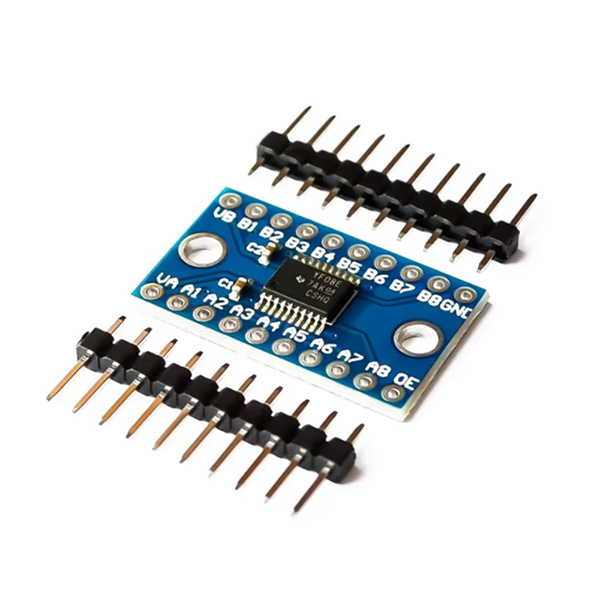
Level Converter is a core electronic device that enables compatible transmission of digital signals in different voltage domains. It mainly solves the problem of logic level mismatch such as 1.2V/1.8V/3.3V/5V, prevents low-voltage chips from being damaged by high-voltage signals, and ensures stable communication across voltage systems.
Features:
1. Wide voltage adaptation range
Support 1.1V~5.5V multi domain interconversion, covering mainstream MCU, FPGA, and sensor voltage standards.
2. Flexible transmission direction
Unidirectional: only supports low pressure → high pressure or high pressure → low pressure (such as TXB0104)
Bidirectional automatic: bus specific for I2C, SPI, UART, etc., without direction control (such as LSF0102)
3. High speed and low latency
The switch speed reaches ns level, supporting 100MHz+high-frequency signals to ensure high-speed communication integrity.
4. Multi channel integration
Single chip can integrate 2/4/8/32 channels, saving PCB area and simplifying circuit design.
5. High reliability
It has ESD protection (± 15kV), wide temperature operation (-40 ℃~125 ℃), and low power consumption characteristics.
Applications:
1. Embedded system
The 3.3V STM32 microcontroller is connected to 5V sensors/relays, 1.8V DSP, and 3.3V peripherals for communication.
2. Consumer electronics
Signal conversion between CPU core (0.6V~1.2V) and interface (1.8V/3.3V), DDR memory in mobile phones/tablets.
3. Automotive Electronics
ADAS、 Communication adaptation between 1.8V processor and 12V actuator/sensor in car entertainment system.
4. Industrial control
PLC、 The interconnection of different voltage logic modules within the frequency converter enhances the system's anti-interference ability.
5. Communication equipment
High speed data buses (such as MDIO, MDC) in base stations and routers transmit across voltage domains.